Showing posts with label DTO_tour. Show all posts

Friday, March 13, 2015

Oakland Women's History Tour

This past Sunday we had a great turnout for a Women's History Tour around downtown Oakland, led by historian Annalee Allen of the city's Oakland Walking Tours and co-sponsored by Oakland Urban Paths. 60 people (and two dogs) met up in front of city hall for a walk through Oakland to learn about some of the amazing women who have called it home.

Our first stop was near the Rotunda Building, originally known as Kahn's Department Store. There a plaque remembers the women of the 1946 Oakland General Strike, which shut down the city completely. Near the Jack London Oak tree we heard about about Jack London and the woman who raised him, Jennie Prentiss, a woman who had been born into slavery.

Then it was on to the first of several beautiful murals we were to see. Mitzvah: The Jewish Cultural Experience is 7 stories tall, and features people and scenes from Jewish history from Oakland and beyond. Two of the people included in the mural are Gertrude Stein and her life-long partner, Alice B. Toklas. Kitty Hughes from the Oakland Heritage Alliance told us more about Stein, her growing up in Oakland, and the infamous "there is no there there" line from her book, Everybody's Autobiography published in 1937. The line refers to Stein's childhood experience being completely gone. The magnificent Tubbs Hotel where the Steins first lived had burned down; the bucolic neighborhood where the Stein's lived was now built up with numerous homes and apartments, and the population of Oakland had grown from 35,000 in 1880, to nearly 300,000 by 1935 when she returned.

A walk down Mural Lane took us to the former YWCA Building, designed by talented and prolific Oakland architect Julia Morgan, then to the site of the former Ebell Society clubhouse, and finally to what is now the Malonga Casquelourd Center for the Arts. It was originally built as the Oakland Women's City Club, then became the Alice Arts Center, so named because it's on Alice Street. Alice Street is one of the few streets downtown not named for a dead white guy; instead it's named for Alice Carpentier, sister of Oakland founding scoundrel Horace Carpentier. There we met up with Jerri Lange, pioneering Bay Area journalist. She's one of the many people featured on the amazing mural across Alice Street, including center namesake Malonga Casquelourd.

Jerri later met up with us at our final stop, Camron-Stanford House next to Lake Merritt. It was home to various families over the years, including the Camrons, the Hewes, and the Stanfords (Josiah, brother of Leland). But more recent Oaklanders know it as the Oakland Public Museum, one of the predecessors of the Oakland Museum of California. There we heard from Reenie (one of the docents who was on the walk with us), Ann Swift (executive director) and several of the docents about the truly amazing women of the Ebell Society. I highly recommend checking out the great exhibit about the Ebell Society that Camron-Stanford House has put together.

Another great walk, and thanks to Annalee for leading it!

More photos from the walk:

Thursday, September 25, 2014

walking tour: Old Oakland


Wednesday I played hooky from work. I started with a walking tour of Old Oakland, one of 8 free walking tours the city sponsors. I've been on the tour multiple times before, but I wanted to hear my friend John Tuttle and I still learn stuff even when I go on the same tour multiple times. One nice addition to the tour that John made was a brief trip into Pacific Coast Brewing to see their historic bar and learn a bit about how beer is brewed. I added in a bit about the history of beer in Oakland. At the time the buildings in Old Oakland were built, beer was a big deal, with multiple breweries (like the Brooklyn Brewery) and countless saloons.

We finished the tour in front of what was the 7th Street train station. One person on the walk was visiting from Canada and expressed interesting in learning more about Oakland in his limited time, so I walked with him past some murals (including the amazing new one on Alice Street), the Tribune Tower, and a few other notable locations. I left him happily checking out the pictures and displays at the Oakland History Room, and returned to Pacific Coast Brewing for some lunch.

The city walking tours are free, at 10AM on Wednesdays and Saturdays through October. They're a great way to learn about Oakland, so check 'em out.

More pictures from the walk and afterwards:

Tuesday, March 4, 2014

walking tour: Chinatown with Mayor Quan and Annalee Allen


Sunday was a special version of the city's downtown walking tour of Chinatown, for a late celebration of the lunar New Year. I've been on the tour of Chinatown before, so I was expecting I'd only learn a few new things. Instead, Mayor Jean Quan not only came on the tour, she co-led it with Annalee Allen, the director of the city's walking tour program. While we went many of the same places and talked about the same people, Mayor Quan had a different and often personal experience of them.

We started in the Pacific Renaissance Plaza, which is home to various shops and restaurants as well as the Asian branch of the Oakland Public Library and the Oakland Asian Cultural Center. Mayor Quan told us about Chinese family associations and early organizations to help Chinese immigrants, the Chinese Exclusion Act, and the experiences of her own ancestors.

After winding around past the Asian Resource Center building, a quick stop for some fresh from the oven fortune cookies, and a look at the Chinatown Dragon Mural, we came to Lincoln Square Park. Normally it's a busy, vibrant place, but because of the intermittent rain, it was empty. We checked out one of the markers for the 10,000 Steps project, a Chinese herb shop, and then we were back to our start. A great tour, and nice to have a different perspective on it—there's always more to learn.

More pictures from the walk:

Tuesday, May 28, 2013

walking tour: churches and temples


It's been a while since I went on any of the city of Oakland's walking tours. The tours are available May through October, so it's been at least since last fall. And although I've been on all eight of the tours, there's no reason not to go on them more than once. I still learn things, different guides emphasize different things, and they're free! I also look at things differently as I learn more about Oakland and its history. There are connections between things that I didn't know about before.

(note: if you're new to Our Oakland, links with the Open Oakland oak logo in front of them go to Oakland Wiki where you can learn more. Several of the tour participants and I discussed the desire to preserve our the amazing Oakland knowledge of our guide and others; the Oakland Wiki is an attempt to do some of that.)

First Presbyterian

This tour was focused on some of Oakland's historical churches and temples. We met in front of the First Presbyterian Church of Oakland. The current building was constructed in 1914, but the congregation goes all the way back to Oakland's founding, and began meeting in a tent near the waterfront at the foot of Broadway in 1853. Our guide was Don Tyler, a retired Oakland history teacher, and the same guide who led the tour when I last took this one two years ago. Don began by telling us about the various religious services that pre-dated the first congregation, including the Ohlone people and the Spanish.

Then we headed to nearby Temple Sinai, the current home of Oakland's First Hebrew Congregation. Like many other houses of worship in Oakland, it had started downtown, but had moved over the years as Oakland grew. Since it was Saturday, services were in progress, so we couldn't go see the interior. The architect of the building also designed movie theaters, so there are a few features reminiscent of the movie palaces of the day.

We walked over Pill Hill to Saint Augustine's Episcopal Church. It's a bright red wooden church building on Telegraph. Through a bit of luck, we were able to go inside to see the interior and hear about the church's history. It began as two separate churches, Trinity Episcopal Church and St. Augustine's. The wooden building narrowly avoided being badly damaged by the Loma Prieta earthquake; seismic retrofit work was finished weeks before the earthquake struck in 1989.

Further down Telegraph we came to First Baptist Church. We were shown around by church member and historian Phil Meads (whose grandfather was one of the church founders). The remarkable building had just been completed in 1904, and Julia Morgan hired to finish the interior in 1906. It was badly damaged by the 1906 earthquake, and so Ms. Morgan was instead hired to repair the structure as well as finish the interior. First Baptist and the nearby Cathedral of St. Francis de Sales had a close relationship, working together on many projects. After the Loma Prieta earthquake, the church was used by the Oakland diocese for services. For more info about First Baptist, see Phil Meads' website.

Then it was over to Lake Merritt to check out the new Catholic cathedral, the Cathedral of Christ the Light. There was some sort of event going on (possibly the installation of the new bishop), with overflow seating filling the plaza, so we couldn't get a very good look at it.

Around the end of Lake Merritt we walked past the Veteran's Memorial Building, and Don told us a bit about it. Before it was built, there were questions about whether a building could be constructed there because it was donated park land. The building was designated a "memorial", and the structure built.

A short distance away is St. Paul's Episcopal Church. The all-brick building is built on land that had been the marshy edge of Lake Merritt, and so was damaged in the Loma Prieta earthquake. It required significant seismic retrofit work. Almost next door is the Whole Foods Market, which is the third major thing that's been in the building. Before the grocery store, it was a car dealership, the Cox Cadillac Showroom. But originally it was a car barn and power plant for the Piedmont Consolidated Cable Company's cable car line. The waste steam was used to heat water for the Piedmont Baths next door. Don and I talked a bit about "Borax" Smith and the Key System since most of people on the tour didn't know about them and were curious about Oakland having cable cars and street cars.

The tour was already running long, but we crossed Harrison to the last church on the tour, the First Congregational Church. Unfortunately we weren't able to go inside, but while Don was checking on that I told people about the Judith Offer play that was going to be performed that evening. Compared to What? is a story set against the backdrop of the Pullman Porters in West Oakland.

A long tour, but a good one!

Lots more photos from the walk:


Read more about the churches and temples on the tour on my post from 2011. There are pictures of the interiors of some of the churches we didn't get to go into this time.

Monday, February 6, 2012

walking tour: New Era, New Politics

Saturday was a specially scheduled walking tour as part of the celebration of Black History Month in Oakland. It's the "New Era, New Politics" tour, and focuses on the more recent history of Oakland.

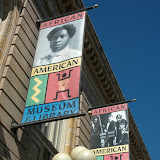
There was a great turnout, 23 people plus our guide, Renate. As when I took the tour last summer, it starts a little slow, with a lot of names and facts in front of the African American Museum and Library of Oakland (AAMLO). But I did learn some new things, such as the identity of the young boy pictured on one of the banners at the museum.

The banner shows Royal Townes, who became the first African American firefighter in Oakland, and was instrumental in helping desegregate the fire department. Royal was born in Oakland in 1899, and when denied union membership in his factory job because of his race, went to work as a railroad porter. He took the fire department application test and easily passed (he was an intelligent young man, and spoke three languages), but because of his race, his application needed a nudge from his former employer. He helped train many other black applicants to pass the test, and was scoutmaster for a Boy Scout troop that included Sam Golden, who went on to become the first African American fire chief in Oakland. There's an interesting paper at UC Berkeley about the desegregation of the Oakland Fire Department (.doc)

There was lots more we heard about, including people that should be familiar to Oaklanders, including: Delilah Beasley, C.L. Dellums, Lionel Wilson, Elihu Harris, Henry Gardner, Morrie Turner, Byron Rumford, and judge Donald McCullum. To read more about some of these names, click the links, and see my post from last year's New Era, New Politics walking tour.

more pictures:


some of the books referenced:

Special shoutout to @kenyaw who was there with lots of friends celebrating his birthday. Happy Birthday, Kenya! And a reminder to support the Oakland walking tours program—it's one of the things possibly on the budget chopping block.

Tuesday, September 6, 2011

Preservation Park walking tour

Park House

Saturday morning I went on the Preservation Park Oakland walking tour. It was the only one of the eight I hadn't been on yet. As with last week's OHA tour of the Dimond, it was led by Oakland historian and author Dennis Evanosky. Even though it was cut a bit short because of private event at Preservation Park, it was another great tour. We had a large group for our short walk around the park.

While writing this post, I discovered a nice series of short videos about the different structures at Preservation Park by Annalee Allen, columnist, author and director of the walking tours program. I'll link to those where appropriate.

There are 16 historic buildings (15 of them houses) at Preservation Park, but only 5 of them are original to the location. The others were all moved there from other locations around Oakland, some as close as across the street and some as far as from the Dimond. The people who lived in them were a who's who of well-to-do Oaklanders from the end of the 19th century and the beginning of the 20th. The ones in their original locations are all north of 13th Street. (video)

ornate details

The first house we saw was the Remillard House. Pierre Remillard was a French Canadian who came west originally for mining. He eventually settled in Oakland, and through hard work began a brick-making business that became very successful -- the Palace Hotel in San Francisco was built with Remillard bricks. A young Jack London took French lessons at the Remillard House from his daughter, Lillian (later Countess Lillian Remillard Dandini). (video)

Next door is the Ginn House, of Ginn & Co. Publishing fame. The company still exists, though as part of the larger Penguin Group of publishers. Frederick Burrell Ginn and wife Mary Crocker lived there. The house was later used by a men's social club, the Nile Club. The Ginn House is Arts and Crafts style, one of the only non-Victorians in Preservation Park. Next door to it is a social hall, which is still used for events and meetings. (video)

At the heart of Preservation Park is the Latham-Ducel fountain, or as it's more popularly known, the Diana fountain. It was originally on the Latham estate near Lakeside Park, but was salvaged from there. After a number of moves in the 60s and 70s, it was rediscovered and brought to the middle of Preservation Park. (video). The Lathams also erected the fountain at the intersection of Broadway and Telegraph.

Nearby is the Queen Anne-style Thornton House. Thornton is listed as a "capitalist". The home was built when the Sather House and Garden occupied the lot across the street. Jane Sather donated UC Berkeley's Sather Gate and Sather Tower in memory of her late husband, Peder Sather.

Higgins House

In the northwest corner of the park is a beautiful Italianate Victorian. It was built by lumber baron Elisha Higgins, and has amazing details. Apparently he put his employees to work on carving all the fine woodwork. It shows a number of features common to classic Victorians, including brackets under the eaves, posts and other details carved to look like stone, and fine carvings all over the place.

On the other side of the bandstand is the White House, which currently houses the Preservation Park office. It was owned by Ellen Gould White and James White, who founded the Seventh Day Adventist church. The White House was one of the houses moved for the building of the I-980 freeway. (video)


There's lots more history about the houses and the people who lived in them than I have time to write about, so here's a brief summary:
  • Remillard House - Pierre Remillard (brick baron)
  • Ginn House - Frederick Burrell Ginn (publisher) and wife Mary Crocker
  • Nile Club - members-only group of Oakland's male elite
  • Thornton House - Thornton ("capitalist")
  • Higgins House - Elisha Higgins (lumber baron)
  • White House - Ellen Gould White and James White (founded 7th Day Adventists)
  • Knox-Buckley House - Henry Knox (dentist), later John and Catherine Buckley.
  • Bartling House - William Bartling (bookbinding)
  • Park House - Charles O. Park (painted train cars for Central Pacific)
  • Robinson House - Gertrude and W.H. Robinson. (fruit wholesaler; house moved from the Dimond, then called Fruit Vale)
  • Standeford House - Miss Stella Standeford, later married John F. Conners (Oakland Enquirer)
  • Bauske House - Reinhold Bauske (dentist)
  • Trowbridge House - Lillie Delger and new husband Henry Trowbridge; father Frederick Wiliam Delger (Oakland's first millionaire)
  • Jacobs House - Jacobs (tailor); house was built as two apartments
  • Raymond House - William J. Raymond (UC physics professor)
  • Hunt House - George C. Hunt (co-owned the City Hall Livery Stables)

more reading:
Wikipedia
all 13 videos
Pardee Home Museum website

lots more pictures:

Monday, August 22, 2011

walking tour: Chinatown

Pacific Renaissance Plaza

Saturday was another great Oakland walking tour. This time it was Chinatown, an area of Oakland I don't know that much about. We met at the fountain in the Pacific Renaissance Plaza, which is a fitting spot as it's where the Asian library branch is, as well as the Oakland Asian Cultural Center. Annalee Allen was filling in for the regular guide, but we were fortunate to also have along a very knowledgeable Chinatown resident, Mr. Wong. And in a bit of good timing, Roy Chan, the director of the Oakland Chinatown Oral History Project was there to tell us about the premiere of the latest installment in that. (More on that here.) Note that it's the Asian library branch and Asian Cultural Center, not Chinese, because Chinatown is really more of a pan-Asian area. The library has collections in 8 different languages (Chinese, Japanese, Korean, Vietnamese, Thai, Cambodian, Tagalog and Laotian) but residents represent even more backgrounds than that.

Oakland's Chinatown has a personal connection for mayor Jean Quan, and so a special version of the walk was done to celebrate her inauguration back in January. Like thousands of others, her great-grandfather and his family came to Oakland following the 1906 San Francisco earthquake. Her father attended Lincoln Elementary School. While the school is still largely Asian American, back then it was because of segregation.

vegis at Chinatown market

As we walked along Webster and a variety of markets, bakeries and other stores, the vibrancy of Chinatown became quickly apparent. There's a lot of people living, working and shopping there, and a ton of energy. We passed the well-known Silver Dragon restaurant, which was designed by past Oakland city councilmember Henry Chang.

The current center of Oakland's Chinatown is at 8th Street and Webster, but it hasn't always been there. Chinese first came to Oakland in the 1850s and settled in shrimp camps along the estuary. Many of them came to work on the transcontinental railroad, dams, and other infrastructure projects. Between moves, fires and forced relocation because of the Chinese Exclusion Act, Chinatown moved 7 more times by 1880. Because of immigration restrictions, early Chinatown was largely a bachelor society.

Chinese Methodist Church

A source of help to fight discrimination and language barriers were various churches in the area. Although the current building is more recent, the Chinese Community United Methodist Church dates back to 1887, and has been at its current location since 1905.

We walked past the remarkable Asian Resource Center building (formerly Lyons storage) over to Harrison Square, one of the original 7 town square parks in Oakland. While I was growing up, it had historical railroad equipment because the transcontinental railroad ran along what is now 7th Street. Now it features Pioneer Hall and a community center.

From there we walked up to another of the original town square parks, Lincoln Square. It was originally called Oakland Square, but renamed to honor president Lincoln. The park at Lincoln Square is a bustling place, with a community center, basketball courts, and the distinctive Chinese junk ship play structure.

junk ship play structure

It was originally a project of the Wa Sung Community Service Club, built back in 1969. That structure was "loved to death", and replaced with a more modern structure in 2003.

The park also serves as the playground for nearby Lincoln Elementary School. Not only did Jean Quan's father attend Lincoln, our guest guide Mr. Wong had attended it as a child, in an earlier building on the same location.

The tour didn't go as far as Madison Square, which is the place for Tai Chi in the mornings. People do lots of other activities there, like badminton, fan dancing, sword dancing, and even line dancing.

There's a ton more to learn about Oakland's Chinatown. You can explore on your own (as I did a while back with yourwaitress), or go on the city-sponsored walking tour (which is free!). An upcoming chance to explore the area and have some fun is the Chinatown StreetFest 2011, August 27-28. Check out any of the 10,000 Steps markers you come across for a bit more history.

Lots more pictures:
Oakland Chinatown walking tour

More resources:


P.S. For those of you who were still with us to the end and wondered about the brass fire hydrant near EBMUD headquarters, Oakland Magazine did a short piece about it. (Follow that link and scroll down until you see the picture of the fire hydrant.) It's a little bit of history, too.

P.P.S. For whoever was wondering about Alice Street among Franklin, Jefferson, Clay, etc., it was named for the sister of one of Oakland's founders, Horace Carpentier. He was also the first mayor of Oakland.

Thursday, August 18, 2011

walking tour: Churches and Temples

Wednesday I had a chance to go on another Oakland walking tour, this time the Churches and Temples tour. As with the other tours, we had an extremely knowledgeable guide, Don Tyler, a former Oakland High history teacher who's been leading history tours since the 1970s. We were fortunate to get access inside many of the buildings, too.


First Presbyterian

Say what you will about churches building huge, fancy edifices, many of them are beautiful, interesting buildings. They're frequently one of the first things people built when they settled an area, so they tend to be some of the oldest structures around, assuming they survived fires, earthquakes, and urban renewal.

We started in front of First Presbyterian Church of Oakland, which you've doubtless seen at 27th and Broadway. I've been in the complex frequently, because that's where Habitat for Humanity East Bay has its offices, but I'd only been in the sanctuary briefly. It's a large English Gothic structure designed by William C. Hays. Its huge organ has over 4,000 pipes, the largest of which are 32 feet tall. First Presbyterian started small, meeting in a tent near the waterfront in 1853 (Oakland was incorporated in 1852), and moved a number of times before constructing the building at 27th and Broadway which was completed in 1916. The history is shown in a series of smaller stained glass windows in the church.


Temple Sinai

Then it was a short walk over to Temple Sinai. That began in 1875 when 18 businessmen formed the First Hebrew Congregation of Oakland. As with First Presbyterian, it moved several times before settling in the current location in 1913. Over the years, the congregation has included such notable Oaklanders as the Capwells (H.C. Capwell department store, later part of Emporium-Capwell), the Kahns (Kahn's department store, noted on the City Center walking tour), the Grodins (Grodin's Menswear store) and Gertrude Stein. Temple Sinai recently expanded their campus, but the 1913 structure still serves as the sanctuary.


St. Augustine's

Another short walk over the south end of Pill Hill took us to Saint Augustine's Episcopal, a smaller but distinctive church on Telegraph at 29th. Originally a black Episcopal church meeting at 27th and West, it merged with Trinity Church at 29th and the combined church kept the name St. Augustine's. The original St. Augustine's is notable because it became a "political and spiritual haven" for the Black Panthers, so it was big news when it merged with the predominately white Trinity Church. The building is a vivid rust red color (you've seen it if you've ever been to the Commonwealth Cafe and Pub across the street) and is built of wood. Inside is stained and varnished, with fine details and a warm color. Additional decorations around the wainscoting are done with lincrusta, a molded linoleum and wood product made to mimic more expensive carved wood. The building was designed by architect William Hamilton. In an amazing bit of timing, earthquake retrofit work was completed on the building just months before the 1989 Loma Prieta earthquake struck, and the building came through fine. Read more about St. Augustine's in Annalee Allen's Tribune article.

Walking down Telegraph to 21st we came to First Baptist Church. The building was completed shortly before the 1906 earthquake, and was badly damaged in the quake. Julia Morgan (the Morgan family lived nearby) had been hired to finish the sanctuary, and was instead hired to repair the church and finish the sanctuary. Many Baptist churches are relatively plain in design; First Baptist is not, with fine wood carving, an open redwood ceiling, and lovely stained glass windows around. The building itself is based on the cathedral in Aachen, Germany, designed for Holy Roman Emperor Charlemagne. A large pipe organ (the sister instrument to the well-known organ in the Stanford Chapel) sits at the front. The sanctuary was featured in the movie "What Dreams May Come". While the First Baptist congregation merged with Lakeshore Baptist in 2010, the building is still in use by the Burmese Mission Baptist Church.


Christ the Light

We then headed towards Lake Merritt to see Christ the Light Cathedral, which was completed in 2008. Unfortunately we arrived just as mass was beginning, so we couldn't go in the sanctuary, but we did take a brief tour of the mausoleum below. In what's a common theme, this building was built to replace the original cathedral that was damaged beyond repair in the 1989 Loma Prieta earthquake.

From there we headed over to the all-brick St. Paul's Episcopal. That was likewise unavailable because of a service, but we stood outside and talked about the retrofit work that has been done to the building -- un-reinforced masonry doesn't do well in earthquakes, though St. Paul's survived Loma Prieta with only minor damage. The Gothic Revival style building was constructed in 1912, and designed by Benjamin Geer McDougall.


First Congregational

After noting the former site of the Piedmont Baths next to Whole Foods, we headed over to First Congregational Church. At this point we were behind schedule, so we didn't get to spend too long there, but it's an interesting building. And F.M. "Borax" Smith was a noted member. The Italian renaissance building with its distinctive tower was designed by John Galen Howard, and opened in 1925. I would have happily kept walking around learning about the churches, temples and people behind them (with a break for lunch, of course), but we were past our scheduled time so we headed back to Broadway where we began the tour.

Lots more pictures:


This is hardly all the notable places of worship in downtown, never mind all of Oakland: the Julia Morgan-designed College Avenue Presbyterian in Rockridge, the First Church of Christ Science on Franklin and 17th, the Greek Orthodox Cathedral, and the Mormon Temple in the hills come immediately to mind. There are lots of other interesting, historical churches and temples around the rest of Oakland, waiting for you to explore.

Additional coverage:
Oakland North

Thursday, August 11, 2011

walking tour: City Center

city hall

Wednesday I went on the City Center downtown walking tour. I was pleasantly surprised to see Annalee Allen herself ready to lead the tour. Also on the tour was C.M. Wilson of OakSnap. (We didn't recognize each other at first, but it's been several years since we last met in person.) There were about 16 of us altogether. Special shout-out to new Oakland resident [C,K]atherine! She and her fiancé moved to Oakland 2 months ago, and she was exploring Oakland via the walking tour.

The City Center tour was more focused on architecture than some of the other tours, and in particular on city hall. It's not surprising, because it is an amazing building and is on the National Register of Historic Places. Construction began in 1911 and finished in 1914, and at the time it was the tallest building west of the Mississippi and the first high-rise government building in the U.S. It's in the Beaux-Arts style, and is an impressive, lovely part of the Oakland skyline. It was part of the wider City Beautiful movement, under the tenure of then mayor Frank Mott. If you've never been there for a council meeting or the like, the wider base contains the mayor and city council offices, as well as various meeting chambers. The upper tower contains offices, and a jail on the 12th floor that's been unused since the 1960's.

But that almost went away in the 1989 Loma Prieta earthquake. Although the building was constructed after its predecessor was destroyed in the 1906 San Francisco earthquake, it didn't fare well in 1989. The building was red-tagged, and was in danger of being destroyed. With some help from FEMA and a lot of work, the building was retrofitted to be earthquake-resistant. Steel beams were added to reinforce the structure, and the entire building was placed on base isolators. As a result, the entire building can move up to 20 inches in an earthquake to protect the inhabitants.

rotunda dome

We also went into the Rotunda building, which formerly housed Kahn's department store. If you haven't been inside, you really, really need to go. It features an amazing glass dome, of the sort they "just don't make anymore".

We also checked out the Lionel J. Wilson building, modeled after the flatiron building in New York, the Tribune tower, the Clorox building and others before ending up at City Center. We got a bit of history on the rise and fall and re-rise of shopping in Oakland, brought on by a variety of things including the rise of the automobile, the building of the Bay Bridge, the construction of BART, and other factors. We finished the tour in the City Center plaza, where they were setting up for the weekly free Wednesday concert. Definitely worth taking the tour to get the scoop on some of the downtown architecture and history behind it.

more pictures:
Oakland City Center walking tour

Tuesday, August 2, 2011

walking tour: New Era, New Politics

The other week I took another of the city-sponsored walking tours. This one was the New Era, New Politics walking tour, which is the newest of the 8 tours the city offers. It also focuses on some of the more recent history of Oakland, though as we learned, that has connections further back, too.

AAMLO

We started the tour in from of the African American Museum and Library at Oakland (AAMLO), part of the Oakland Public Library system. Alas, since it was a Monday and the AAMLO was closed, I couldn't check out the museum afterwards. The building itself is interesting, one of 5 libraries built with funds from Carnegie. But what's of real interest are the collections it houses. In 1946, Eugene and Ruth Lasartemay and Jessie and Dr. Marcella Ford began collecting the oral histories and artifacts that documented the activities of African Americans in and around Oakland, the Bay Area and California. After combining with other collections and various moves, the collection ultimately became the AAMLO in 1994. Read more of the history of the AAMLO collections on the OPL website.

Judge McCullum

During the tour, there were a ton of names from Oakland's history, some you doubtless recognize, and probably a few you don't.
  • Did you know Jack London was raised by ex-slave Jenny Prentiss? He later borrowed money from her to buy his first boat, and left money to her in his will.
  • That section of highway 24 named the Rumford Freeway? That's named after William Byron Rumford, the first African American elected to public office in Northern California. He also was one of the early fighters against automotive air pollution. Besides the freeway, there's also an Oakland post office named after him. Ironically, it's one of the post offices slated to be shut down.
  • Oakland's Youth Court? It's named for civil rights activist and superior court judge Donald McCullum.
  • mayor Lionel Wilson was the first African American mayor of Oakland.
There were lots more people of note, including Bob Maynard, George Scotlan, Elihu Harris, Ron Dellums, C.L. Dellums, Henry Gardner, Curt Flood (I ride past Curt Flood field on Coolidge), and more.

I have to admit the names and facts were kind of a blur, because we spent the first 30 minutes standing outside the museum. It was tiring to stand in one place for so long, and it made it harder to remember the names and associated facts because there wasn't a place to associate many of them with. But it was a still a good, informative tour, and worth checking out.

More pictures in my Oakland New Era, New Politics walking tour album:
Oakland New Era, New Politics walking tour

Wednesday, May 18, 2011

walking tour of Uptown

Paramount Theatre

This morning I took another Oakland walking tour, this time of Uptown. As with Downtown, there's some disagreement about the exact boundaries, but I think of it as below Grand, east of San Pablo, and what's not part of Downtown or one of the other parts of the DTO over to Lake Merritt. My non-definitive bounds can be viewed on the neighborhoods map. And the tour is about Oakland history with a focus on Art Deco, not an exact area, so we were into Downtown a little on the tour, too.

Anyway, on to the tour. I loved it. It helps that the tour is of one of the most vibrant areas of Oakland, and it focuses on Art Deco style, which I generally love. We started in front of the Paramount Theatre, which was completed in 1931, and exemplifies Art Deco design. As happens all too often, the building had fallen into disrepair, but the Oakland Symphony Orchestra Association bought it and had it authentically restored in 1973 (as our guide said, "before restoration was in"). It features beautiful murals, an awesome sign (especially when it's lit up in the evening), and more. The building is worth a post of its own or 3; they have tours monthly, so I'll probably do that at some point. I talked with my mother-in-law this evening, and she remembers being taken to see "The Wizard of Oz" by Mrs. Truitt (of Truitt and White Lumber fame) at the Paramount in 1939.

I.Magnin building

Nearby is the I. Magnin building. Once a high-end department store, it now houses offices and Cafe Madrid. Besides the remarkable green color, it's also notable for the terracotta facade. Above and below the windows are remarkably intricate panels, and the subway-style tiles in between give the appearance of large bricks.

window flashing

Across the street is now the Sears building, but was originally an H.C. Capwell's department store. An earth-toned brick building completed in 1929, it was damaged in the 1989 Loma Prieta earthquake. To get back into business quickly, they covered the brick with an ugly concrete shell, but they did leave many of the details intact. Our guide pointed out the special metal window flashing, which at the time revolutionized storefront windows. (I can't find the reference to the name, but it was a company in Kansas.) In another bit of personal connection, the first job my mother-in-law had out of college was H.C. Capwell's in the early 1950s. They had a strict dress code for employees, and had 'secret shoppers' who would both help make the store look busier and keep an eye out for shoplifters.

Then it was around the corner to the building that the Uptown Club and Flora share. More amazing terracotta, this time blue, and with metallic silver finials. The new-but-great sign at the Uptown was partly funded by a program to restore and compliment facades in historical Oakland buildings. This same program helped remove the facades on the Columbia Outfitting building and the Bibliomania building across from the Fox.

Fox Theater

Reflected in the windows of Flora is the also amazing, also worthy-of-a-blog-post-of-its-own Fox Theater. The Fox was completed in 1928, and lasted as a movie palace until 1966. It deteriorated after that, but in 1978 Erma and Mario DeLucchi bought the property in hopes of restoring it and saving it from the fate of San Francisco's Fox Theater, which had been demolished in 1963. The couple had gone on Saturday night dates at the Oakland Fox as high school sweethearts in the early 1930s. A nice connection was that the husband of one of the people on the tour had worked on the restoration, helping restore and blend with the terrazzo flooring at the entrance.

Then it was past more amazing buildings, the newly restored Art Deco clock on Broadway, past the new Oaksterdam mural, and to the remarkable Howden Building, home to various shops, offices, and the Spice Monkey restaurant.

Kaiser Center garden

At this point, it would have been a great tour already. But then it was over to Snow Park near Lake Merritt, to see remnants of former estates, including one owned by A. Schilling, of Schilling Spices (bought out later by McCormick.) Then through Snow Park to the Kaiser Center, where the Oakland Indie Awards were just held. More than half the of the people on today's tour were Oakland residents, but most of them had never seen that beautiful space. We then worked our way back over to the Paramount to complete the tour, but I continued wandering around to take more pictures on this gorgeous Oakland day.

More pictures in my Oakland Uptown walking tour album.

Thursday, May 12, 2011

walking tour of the Waterfront

Unlike the awesome weather for the walking tour of Old Oakland, yesterday was windy and overcast. As a result, the attendance for the walking tour of the Waterfront was low -- the guide, Pearl; a woman from Singapore who was visiting her sister in Alameda; a fellow Oaklander who read about the tours here on Our Oakland; and, of course, me.

From Oakland Waterfront walking tour
The Waterfront walking tour takes you around Jack London Square and the Produce/Warehouse district. The square is named for author Jack London, who spent long hours at Heinhold's First and Last Chance Saloon. He studied at the tables as a child, and John Heinhold even loaned London money to attend UC Berkeley to learn to become a writer. He only lasted a year there, but was inspired by stories at Heinhold's and went on to a distinguished writing career.

From Oakland Waterfront walking tour
The tour also highlights Oakland's history as a shipping port. Alameda wasn't always an island; the estuary was dredged to allow ships further in. The current container ships are too large to go any further than the port, but the dredging allowed smaller ships to go all the way to San Leandro Bay. The area of JLS is where the ferry to Alameda and San Francisco docks, and is home to the Oakland police and fire rescue boats as well as the USS Potomac, Franklin Roosevelt's presidential yacht. (The Oakland Fire Department also has a fire boat (called the Sea Wolf, for the Jack London book), featured in this KTVU video. It wasn't there, and I'm not sure of its current status.)

From Oakland Waterfront walking tour
The district is referred to on some maps as 'Produce and Waterfront', and that's because a large number of wholesale produce sellers sell their goods there. But signs in the area also refer to the Oakland Waterfront Warehouse District. I don't know how many active warehouses there are in the area (these days there are a lot of condos and offices), but there are some amazing historical buildings that were once warehouses and factories.

I didn't learn as much on this tour as the one of Old Oakland, but I think that's mostly a reflection on having learned so much on the first tour -- it's tough to top top a tour led by Annalee. In any event, I highly recommend checking out one or more of the Oakland walking tours of any of the areas of Oakland that interest you.

See more photos in my Oakland Waterfront walking tour album:

Thursday, May 5, 2011

walking tour of Old Oakland

From Old Oakland walking tour
Oakland turned 159 yesterday! In celebration, yesterday was the first downtown Oakland walking tour of 2011, which appropriately enough was of Old Oakland. It was led by Annalee Allen, who is a storehouse of knowledge about Oakland's history. As well as working for the city part-time to run the tours program, she also writes for the Tribune, and has authored several books on Oakland history.

From Old Oakland walking tour
There were a number of significant events in Oakland history that helped form what is now Old Oakland. First was the discovery of gold in the California foothills in 1848. Then the completion of the transcontinental railroad in 1869 made it a lot easier for people to come from the eastern U.S. to the west, instead of going slowly overland, rounding Cape Horn (which was a long, dangerous voyage), or cutting across the isthmus of Panama. Not everyone was directly in search of gold; some came to provide supplies to gold miners and make their fortunes that way. And of course the 1906 earthquake caused many people who'd set up shop in San Francisco to move to the East Bay, including Levi Strauss.

From Old Oakland walking tour

For more pictures, see my Old Oakland walking tour gallery.

There was tons of interesting information about Old Oakland, the people who created it, lived and worked there, and the forces behind its creation, demise and restoration. If you're interested in Oakland, I highly recommend taking one or more of the tours. There are walking tours of the DTO focusing on different areas:
  • Old Oakland
  • City Center
  • Uptown to the Lake
  • Preservation Park
  • Chinatown
  • Jack London / Waterfront
  • Churches and Temples
  • New Era / New Politics
There are also walking tours put on by the Oakland Heritage Alliance that cover different areas of Oakland.