Wednesday, August 3, 2011

upcoming Oakland events

More fun stuff in Oakland than there's time for!

Waterfront Flicks - Thursday, August 4, sundown at Jack London Square. This week's movie is Ratatouille. There will be pet rat adoptions from Razzie Rats, food from Miss Pearl's Jam House, beer from New Belgium via East Bay Bike Coalition, and cooking demos. A benefit for the Alameda County Community Food Bank. (free)

Dishcrawl - Friday, August 5, 6pm. A new (to Oakland) food event, this one in Uptown. This is the inaugural event, starting at Uptown Place. ($26, limited tix)

Secret Stairs book signing, Friday, August 5, 7:30pm at Pegasus Books on Solano, in Berkeley. Author Charles Fleming will be in town for a discussion and book signing of Secret Stairs: East Bay that I reviewed recently. There has also been discussion of him leading one of the walks on Saturday.

Urban Wine Xperience - Saturday, August 6. Put on by the East Bay Vintner’s Alliance that sponsored the event featuring Oakland wineries back in April. The Urban Wine Xperience pairs East Bay vintners with local restaurants and food sellers to put their creations together. Instead of traveling to the different wineries, this event is all at the Jack London Pavilion. ($40-$60)

10,000 Steps - Sunday, August 7. 10,000 Steps is a project that was years in the making, celebrating Oakland's downtown parks and history. Join them for a free-admission day at OMCA, with family-friendly events including a docent-led bike tour of historical downtown Oakland, tamale-making demonstration, tai chi for all and lots of other fun hands-on art activities. There are now permanent sidewalk markers around the tour, many of which have associated audio

Throw Down for the Town - Saturday, August 13, 10am-6pm. The Ella Baker Center is organizing service projects all over Oakland, followed by a party at Mosswood Park. Come out and help make Oakland a better place!

Laurel Street Fair - Saturday, August 13, 11AM-6PM. The 12th annual Laurel Street Fair, featuring music, food, crafts, and a whole lot of community!

Plus the usual events that I haven't listed this time.

Bites off Broadway (Fridays)
Dancing under the Stars (Fridays)
Downtown walking tours (Wednesdays and Saturdays)
OHA walking tours (Saturdays and Sundays)
Art Murmur (Friday, August 5)
Saturday Art Stroll (Saturdays)

For even more, check the Visit Oakland event calendar.

Tuesday, August 2, 2011

new digs

Ifinally took the plunge and got my own domain. Without further ado, welcome to OurOakland.net! Old links to blogspot.com should still work, just redirect to the new location. To celebrate the move, I created a new logo, with a familiar look to it:

walking tour: New Era, New Politics

The other week I took another of the city-sponsored walking tours. This one was the New Era, New Politics walking tour, which is the newest of the 8 tours the city offers. It also focuses on some of the more recent history of Oakland, though as we learned, that has connections further back, too.

AAMLO

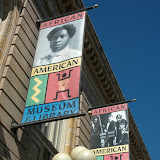
We started the tour in from of the African American Museum and Library at Oakland (AAMLO), part of the Oakland Public Library system. Alas, since it was a Monday and the AAMLO was closed, I couldn't check out the museum afterwards. The building itself is interesting, one of 5 libraries built with funds from Carnegie. But what's of real interest are the collections it houses. In 1946, Eugene and Ruth Lasartemay and Jessie and Dr. Marcella Ford began collecting the oral histories and artifacts that documented the activities of African Americans in and around Oakland, the Bay Area and California. After combining with other collections and various moves, the collection ultimately became the AAMLO in 1994. Read more of the history of the AAMLO collections on the OPL website.

Judge McCullum

During the tour, there were a ton of names from Oakland's history, some you doubtless recognize, and probably a few you don't.
  • Did you know Jack London was raised by ex-slave Jenny Prentiss? He later borrowed money from her to buy his first boat, and left money to her in his will.
  • That section of highway 24 named the Rumford Freeway? That's named after William Byron Rumford, the first African American elected to public office in Northern California. He also was one of the early fighters against automotive air pollution. Besides the freeway, there's also an Oakland post office named after him. Ironically, it's one of the post offices slated to be shut down.
  • Oakland's Youth Court? It's named for civil rights activist and superior court judge Donald McCullum.
  • mayor Lionel Wilson was the first African American mayor of Oakland.
There were lots more people of note, including Bob Maynard, George Scotlan, Elihu Harris, Ron Dellums, C.L. Dellums, Henry Gardner, Curt Flood (I ride past Curt Flood field on Coolidge), and more.

I have to admit the names and facts were kind of a blur, because we spent the first 30 minutes standing outside the museum. It was tiring to stand in one place for so long, and it made it harder to remember the names and associated facts because there wasn't a place to associate many of them with. But it was a still a good, informative tour, and worth checking out.

More pictures in my Oakland New Era, New Politics walking tour album:
Oakland New Era, New Politics walking tour

Monday, August 1, 2011

walking tour of Shepherd Canyon

Saturday was another Oakland Heritage Alliance walking tour, this one closer to home for me than most. It centered on Shepherd Canyon in Montclair, and was called "Back to the Future: A Shepherd Canyon Walk Through History". Led by Shepherd Canyon resident Mike Petouhoff, we learned about the transit that was, the transit that is, and the transit that fortunately did not come to be. Mike is not only a resident, he's president of the Shepherd Canyon Homeowners Association (SCHA) and has been an activist to preserve and improve the area. As a result, he's extremely knowledgeable about the area, past efforts, and plans for the future.

The tour started near the Montclair recreation center, and was very well organized even though we had a large group. After check in, we headed through the park and saw the first signs of past transit. Along Mountain Boulevard, there are two large concrete walls. Many residents don't realize those are left from the days when the Sacramento Northern Railway ran behind the village. There have been plans floated about to paint murals on the walls facing the street, with one perhaps showing the railroad in action.

on the railroad trail

We then walked through the village, and up the short but steep climb up to the railroad trail (for reference, there's a less steep route, too.) This wide, level trail follows the old railroad right of way, which makes it ideal for walking and biking -- it's part of my bike route home. Along the trail there are various interpretive signs about the history installed by Eagle scout Daniel Levy. Originally, the Sacramento Northern was primarily for passengers, but later carried mostly freight. Conspiracy theorists will be pleased to note there really was a conspiracy by GM, Firestone, Standard Oil and other companies that helped lead to the demise of electric streetcars and interurban railways around the U.S. But the Sacramento Northern also faced increasing competition from shorter, less steep railroad routes. Passenger service on this part of the route ended in 1941, the final electric train on the SN was in 1965, and the last vestiges of the SN were folded into the Union Pacific in 1983.

Further up the trail, we learned about the freeway that was never built. CalTrans bought up land in Shepherd Canyon with the plan of building highway 77. It was to be an extension of Park Blvd., and would run up the canyon and connect highway 13 with Contra Costa county (much as highway 24 does just two miles north). Fortunately, community activists argued against the plan, and the area was preserved. In 1972, assembly member Ken Meade officially protected the area with AB561. After the downfall of the freeway plan, the Shepherd Canyon Corridor Plan was shaped by volunteers, and now guides the preservation of the canyon.

Torii Gate

We then crossed over Shepherd Canyon Road, via a crosswalk that's not yet been built. We walked up Escher Drive (probably the most energetic part of the walk), and came to a trail head marked by a Torii Gate. This was added fairly recently, and serves to mark the trail head, indicate potential pedestrians, and also nicely frames a view out over the canyon. We then followed the trail down to the upper meadow. OHA had a display showing what the meadow used to look like, back when the city used it as a dump for debris. An EIR done many years ago was used to leverage the city into cleaning up much of the debris, but the SCHA continues to work to beautify the meadow and return it to a more natural state.

From there we headed down the canyon to the playing fields in Shepherd Canyon Park, saw where Shepherd Creek comes to the surface, walked past fire station 24, back up to the railroad trail and back to the village where we began. It was a great tour, and although I knew some of the history, the work done south of Shepherd Canyon Road was all new to me.

A note on the spelling. The street and most maps refer to "Shepherd Canyon", yet the creek is sometimes referred to as "Shephard Creek". No one seems quite sure where the discrepancy came in, but the area was named for a farmer, William Joseph Shepherd, who came from England in 1869.

More reading:

Lots more photos from the tour here:
Shepherd Canyon walking tour

Saturday, July 30, 2011

16th Street station

16th St. Station

Thursday evening was a celebration of the 16th Street train station in West Oakland. It was put on by RAILS, Restoration Association for Improving the Landmark 16th St. Station, which is sponsored in part by the Central Station building group, BRIDGE Housing.

It's all part of a larger effort to save the 16th Street Station, which was closed to regular use after the 1989 Loma Prieta earthquake. It was built back in 1912, and at the time, the waters of the bay came right up next to the tracks. The station is also notable because of its history with the Brotherhood of Sleeping Car Porters. It's also a reminder of how transit can be -- trains arrived at ground level, then passengers went upstairs and boarded Key Route trains to the rest of the East Bay or to San Francisco.

16th St. Station

For the event, they had various food trucks including Fist of Flour, Guerrilla Grub, and El Taco Bike, and performers from Trapeze Arts. East Bay Bike Coalition provided free bike parking. CM Nadel and Mayor Quan spoke (though that was before K and I got there; we saw Mayor Quan headed to her Prius as we were walking towards the station.)

To me, one of the big draws was being able to go inside the station. I saw the station while HBO was filming there (apparently a biopic about Ernest Hemingway), and had seen it many times before, but I'd never been inside. It's a gorgeous building, with high ceilings, wonderful Beaux Arts details, and marble floors.

More coverage on Oakland North, OakSnap and ABC 7.


Lots more photos:
16th St. Station