Showing posts with label black history. Show all posts

Sunday, February 13, 2022

Who was George Turner?

This photo shows up every once in a while, with variations on the same basic info: "A George J.P. Turner operated as bootblack from early 1900's to about 1918 according to Oakland City Directories. Had shops listed at various places including Narrow Gauge Depot on Franklin, 14th street and Clay street in Oakland." It's from the California State Library (CSL).

Coming across the photo again, with a higher resolution than the usual copies, I decided to take a closer look at it, both literally and figuratively. Who was George Turner? Where and when was the photo taken?

I started by trying to confirm the information above from CSL. I never did find a mention of a location on Clay St., but the rest seemed mostly accurate if a bit vague. The 1913 directory listed both 411 - 14th St. and 501 - 14th St. The latter was probably the source of the Clay St. mention, but the address was at the no longer extant intersection of Washington and 14th, across from city hall, a block from Clay. In any event, the directories all showed the 411 address, so we had a likely location for the photo.

Given that "George" and "Turner" are fairly common names, George was Black living in the early 1900s, and he was a shoe shiner not a politician or the like, I didn't expect to find much in the Oakland Tribune archives. But I got lucky, and found his obituary from 1919. This didn't give me many facts besides the date of his death, but it was a start. It also let me know that George was someone people remembered, and he had been in business for about 20 years.

Next I found references to George being married, punctuated by this vignette about the ceremony in 1889. It was the first marriage performed by superior court judge John Ellsworth. It tells us Turner was married, and his wife's name was Josephine. Now we're getting somewhere! For the record, Judge Ellsworth says he did not kiss the bride as was the custom of Judge Gibson.

While continuing the search through the Tribune archive, I created a family tree on ancestry.com and started looking at the Sanborn insurance maps. I usually do the first when researching a person or family, and the second when researching the location of a home or business. Oakland has changed a lot over time, not the least of which are street names and street addresses (sometimes more than once), so finding historical locations for an address can sometimes be a bigger challenge than you might think.

Even knowing his wife's name, the approximate year of his birth, and the date of his death, researching the family tree didn't turn up much besides (probably) narrowing down George's birth to April 1861 in Virginia. But it did give some addresses for where the Turners lived, and suggested they probably didn't have any children.

Looking at the Sanborn insurance maps proved a bit more fruitful. The 1911 Sanborn for 411 - 14th shows a location in a building between the MacDonough Theatre and the previously mentioned narrow gauge railroad station. Looking more closely at that showed a building labeled "Boot Black" immediately behind the station. OK! This along with the directory info suggested that sometime between 1911 and 1913 is when George moved his parlor from the near the station to 411 - 14th St. Refining the search in the Tribune archives turned up a classified notice confirming the move. In 1912, George was compelled to move his stand from near the train station to 411 - 14th St.

Did George start his business behind the train station? And if not, where? More searching turned up this notice of city council actions, indicating that in 1903 they passed a resolution allowing George to build a metal building near the train station. Now we've got some better parameters. From c.1903 to 1912 he was near the train station, and from 1912 until at least 1918 he was at 411 - 14th St.

Based on the building in the photo, we can probably rule out the metal structure near the train station. So most likely we're looking at 411 - 14th St., unless it's the c.1913 location of 501 - 14th St. Looking at later photos of 501 doesn't suggest that, but doesn't rule it out, either. So I set about looking for photos of that area from the appropriate time, but with no luck. Other than the MacDonough Theatre at the corner of 14th and Broadway, I didn't know any building names or businesses to reference for refining the search.

But then I remembered the 1909 photo of Albert Vander Naillen and Captain Park A. Van Tassell's launch of the City of Oakland balloon that shows that area. Suddenly it clicked, that the vague letter forms on the sign at the top of the original photo matched the "Tribune" sign visible in the 1909 photo. Bingo! The location matched, the time range matched...we have a location!

The time range is still fairly broad, though. It could be any time after the 1912 move, and probably before George's death in 1919, but not necessarily. How do we narrow down the time? (Now we're starting to get into the serious history nerd range.)

If you look closely at the right side of the CSL photo, you'll notice a poster for the Pantages Theatre which was nearby on 12th St. The sign is mostly illegible, but "Co-Eds" is visible near the top, and "Clara ??? Co." with a production called "Self Defense" is visible near bottom. Combining those with the date range turns up a brief article from October 1, 1914, describing the latest offerings at the Pantages, including "The Fair Co-Eds, Menlo Moore's newest musical tabloid of campus life" and "Clara Beyers and co. in a tense playlet entitled Self Defense."

Before we can declare victory and say the photo is from 1914, consider that plays and theatrical performances sometimes run for a long time, and sometimes are revived at later dates. So looking closely at the photo again, notice the smaller poster near the center. That shows "D? Wolf" and "Trial by "Ju?". Narrowing the search with all the above, we come to "Trial by Jury" featuring DeWolf Hopper, playing at the Greek Theater in Berkeley. While this still doesn't pin the date down exactly, it's further evidence for late 1914.

None of this is absolute, though the location of the CSL photo seems to be pretty conclusively at 411 - 14th. And the facts suggest late 1914 for the date. Like a lot of things in history, the day and time may never be known. But now at least we know where the photo was taken and have a pretty good idea on when.

But back to George and Josephine. We know when they were married, and when George died, but not much else. Did they have children? What did they do besides work?

Continuing the search in the Tribune archives turns up a death notice for George. This is shorter than his colorful obituary, but tells us a bit more. George was a Mason. His body was prepared at the Hudson and Butler Funeral Home, and a funeral held at the First A.M.E. Church, which was then on 15th Street. And his remains were interred at Evergreen Cemetery. But no next of kin mentioned, adding credence to the theory that he and Josephine didn't have any children. And why isn't Josephine mentioned?

The same edition of the Tribune also turns up a brief article noting that George left a will, but it was declared invalid. Josephine had died about 6 months before, George died following an operation for appendicitis, and... they had two adopted children?

This is sadly where the trail goes cold, at least for now. I haven't found any further mentions of adopted daughter, Genevieve Howard, or adopted son, Brown. Hopefully more information will turn up over time. But at at least we know a little more about George and Josephine Turner.

Friday, February 7, 2020

Black Panther Power tours

Steve McCutchen, Dr. Saturu Ned, Katherine Campbell at de Fremery House in Lil' Bobby Hutton Park
There are a number of walking tours around Oakland, especially if food is your thing. When it comes to tours focused on history, there are fewer options: Oakland Urban Paths, Oakland Heritage Alliance, city of Oakland walking tours, and Mountain View Cemetery. And when it comes to black history tours, there's only one regularly scheduled tour, the city of Oakland's "New Era, New Politics" tour, which occurs on various Wednesday and Saturdays, May through October.

"New Era, New Politics" focuses on the political changes that came about in Oakland as African Americans started being elected to city council, mayor, and other positions. I've led it a number of times, and people are sometimes disappointed that it doesn't cover more about the Black Panther Party. When I give it, I talk about Bobby Seale's run for Oakland mayor, but there's too much to cover in 90 minutes.

So once a year, Oakland Urban Paths and the city of Oakland walking tours program team up to do a 2.5 hour walking tour on black history in Oakland. That gives time to talk about more people and cover more topics, though it's still not enough time to do more than give a taste. I always encourage people to find out more, with OaklandWiki.org a good starting point. But it's best to learn about a place from people who lived the history, and as well as I know Oakland history, I was too young when the Black Panther Party was active and I definitely didn't live the history.

That's why I was really excited to get an email from Visit Oakland, the local visitor's bureau, asking if I wanted to go on a Black Panther Party tour, led by a former BPP member. I went on a BPP tour of North Oakland a couple years ago (2014) with It's About Time and learned a ton, but as mentioned, there aren't regular tours, so I jumped at the chance to go on this.

And I wasn't disappointed. Saturu Ned, who started with the BPP in Sacramento led the tour, along with Kathy Campbell and Steve McCutchen. Each of them had stories to tell and personal details to add to their time with the BPP. We toured sites in West Oakland (e.g., the BPP party headquarters), North Oakland (e.g., Merritt College, where Huey Newton and Bobby Seale met and formed the BPP), East Oakland (e.g., the BPP Community School) and finished up back by Lake Merritt, where we could see the courthouse steps, site of the "Free Huey" protests, and 1200 Lakeshore, where Huey lived for a time under tight security.

If this wasn't enough, it wasn't just a one-off. It was in part to announce that Black Panther Power led by Saturu Ned will be giving regular (or at least more frequent) BPP history walking tours. The details haven't been announced yet, but you can add yourself to the email list at blackpantherpower.com to learn more.

Whether or not you go on the BPP history tours or not, there's lots to do for Black History Month in Oakland. Check Visit Oakland's list of BHM events, as well as the list on the Oakland Wiki.


Saturday, March 3, 2018

Mountain View Cemetery Black History Month Tour

The following is a guest post by Sarah Wilson. Thanks, Sarah!


Mountain View Cemetery's 2018 Black History Month tour began at 10 a.m., on February 24th, in front of the cemetery's administrative office. I arrived a few minutes early and easily found a place to park. (Free and easy parking is to me as rare and valuable as pirate-treasure.) I saw people walk inside the office, and a woman stood in the lobby with a clipboard. I assumed that the woman was the tour organizer, and if not, a clipboard made anyone look official and attention-worthy. I followed the others up the steps and inside.

I opened the wide door and paused, not wanting to bump another person who stood inside the doorway. I waited as that person moved, and then I slid inside. I felt grateful for the warmth. The sun fell warmly, and I dressed warmly, but not warmly enough. The temperature hovered between 55 and 60 degrees. I wished I had a scarf to add to my long-sleeve shirt, sweater, jacket, and gloves.

"Sign the clipboard to get on our mailing list." The woman lifted her clipboard into the air. My eyes followed the upward movement, but kept going, to the vaulted ceiling. I knew nothing about the architectural style that surrounded us but guessed that it was Victorian, or Gothic. I noticed that behind me stood a miniature model of the cemetery. I noted the tiered layout of the grounds, or the model's way of representing significant changes in elevation. Either way, the cemetery expanded over the nearby hillsides. In fact, the model showed minimal flat ground.

More people arrived outside. Those that stood with me in the lobby were a mix of ages, men and women, black and white. If I were to guess, I would say that there were a few more women than men, and about 30 people total. I anticipated that the tour would begin soon, given the nearness to the hour, and went back outside. I found a sunlit patch of sidewalk and stood and tried to ignore the cold.

"There will be vans, or you can drive yourself, or you can ride with one of us," Lydia said. Lydia was the woman with the clipboard, professionally dressed for a Saturday. She had a scarf, which I envied.
"Can we walk?" Someone expressed what others likely felt -- the expectation that the tour was a walking tour.

"You can, but we will wind our way up and around. You'll have to follow our caravan, and it's quite a trek." I spied the nearest white van with the cemetery logo on the side and edged toward it. "Anna is here," Lydia sang. "Good."

I looked for 'Anna,' but did not see her. Anna blended into the background until she spoke. She did not raise her voice, and the group quieted. Anna introduced herself as a docent and tour-guide. Finished, she moved from where she stood on the steps next to Lydia.

I edged closer to the van, but Lydia said that we had a "stop, just over here." We moved a few yards from the office steps, and Lydia pointed to a stone structure behind her, about 200 yards away. Five or six rows of large, square, stacked sections rose four or five sections high. I did not know the cemetery-term for the structure, which obviously entombed remains. I found out later that the structure was a mausoleum. "The last time we gave this tour, last year, we said that this cemetery was never segregated," Lydia said. "We were wrong. We only just found out the truth, from records we uncovered."

In 1955, or thereabouts, Clara Mae Long, a black woman, intended to lay her husband to rest inside a mausoleum at Mountain View Cemetery. The cemetery denied Ms. Long's request, because that particular mausoleum was set aside for whites. Ms. Long sued, and the resulting case, Long v. Mountain View Cemetery Association (1955), ended in a California Court of Appeal. The Court of Appeal upheld the lower court's ruling, affirming that though Civil Code Sections 51 and 52 ensured all citizens equal access to public accommodations, the law's provisions did not include cemeteries.
However, the presiding judge wrote that he could not resist a word of protest:
"I cannot believe that a man's mortal remains will disintegrate any less peaceably because of the close proximity of the body of a member of another race, and in that inevitable disintegration I am sure that the pigmentation of the skin cannot long endure. It strikes me that the carrying of racial discrimination into the burial grounds is a particularly stupid form of human arrogance and intolerance. If life does not do so, the universal fellowship of death should teach humility. The good people who insist on the racial segregation of what is mortal in man may be shocked to learn when their own lives end that God has reserved no racially exclusive position for them in the hereafter."
I felt uplifted by this story and the judge's sentiment, if not by the Court's decision. I liked that Lydia and Anna chose to bring the story and the judge's assertion to our attention. Others murmured their approval, and someone chuckled at the situation's audacity. On that note, it was time to board the tour-caravan.

En route, our driver explained that the cemetery stretched for 230 acres. That sounded large, but I felt more impressed by the variety of headstones and monuments on display – modest ones, ornate ones, and ones laden with unfamiliar symbols. It took less than two minutes to wind our way up to our first stop, and that timing remained true for the tour's entirety. We visited the grave of local hero Captain William T. Shorey, a.k.a. The Black Ahab, and local legend Bobby Hutton, the first member of the Black Panthers. At each stop, we learned about people who enriched or affected the lives of many and thus, did the same for Oakland's history.

I came away with a sense of what I would like my eulogy to say, a realization I valued. But, in truth, I attended the tour for a purpose. I sought Virginia Prentiss's final resting place and an answer to a question on her behalf: How could Ms. Prentiss, a significant member of Oakland's historic black community and Jack London's surrogate mother, be laid to rest without a headstone?
"Virginia Prentiss was buried here," Anna said, on our third of fourth stop. She gestured to the ground. "Probably about right... there." Anna pointed to the feet of a fellow tour-goer. He laughed and took his cap off and pressed it to his chest.

In that moment, I felt grateful for the cemetery's well-kept records. Otherwise, we simply stood at the top of a hill, under a tree, a few feet from a burial site for Elks-Club members. The rest of what Anna said about Ms. Prentiss, I already knew: that Ms. Prentiss was born a slave in 1832, escaped soldiers of the Civil War, married Alonzo Prentiss, and found her way to California, where she raised her children and became a mother-figure to an icon of American literature. She died in 1922.

I wanted to approach Anna as she stood under Ms. Prentiss's tree, but decided to wait. Just prior to the tour's end, and when I thought I could no longer tolerate my cold-induced sniffles, we found Alonzo Prentiss's grave. Mr. Prentiss lay in the veteran's section, near a Civil War memorial and burial plot.

"Why weren't Alonzo and Jennie Prentiss buried together?" I asked Anna as soon as I saw an opening to approach her, as the tour concluded, and the others departed. Anna shrugged and said something like, no one expects to outlive their children. I remembered then that the Prentiss children died young. So, their plot had room for mother and children only. Then, I asked my big question.

"I know," Anna agreed, "why spend the money on a plot and not include a headstone?" She shrugged. "I don't know the answer."

At that moment a woman with owl-rimmed glasses, who rode in Anna's car from one place to the next on the tour, interrupted us. Unsure that I hid my disappointment in her answer well enough, I left Anna to climb back up the hill with the elk statue at its peak. I shunned the paths for the direct route, wondering about graveyard customs along the way. Was it disrespectful to walk over a grave? Was it poor form to snack in a graveyard? One should not pick a flower that grew in a graveyard, I felt, (though I am not superstitious). I wondered what Ms. Prentiss would think about Black History Month, knowing that she viewed whites as ungodly, given their un-Christian treatment of black people.

I reached the unmarked plot for the second time and felt grateful for the solitude. I took pictures and hoped to share them with other Oakland-history buffs, who may also feel unsettled by Ms. Prentiss's unsung status in the cemetery. I resolved to return to Mountain View Cemetery, perhaps for one of their other tours. I hoped to build on what I knew about Ms. Prentiss:
  • Virginia Prentiss died at around 91 years old, at Napa State Hospital
  • Jack London's will included provisions for Ms. Prentiss's burial expenses
  • Charmian Kitteridge, Jack London's second wife, was the executor of his estate
  • Ms. Prentiss died on Ms. Kitteridge's 51st birthday, in 1922

Thanks to the tour, I learned that the wealth of history that resides at Mountain View Cemetery cannot be overemphasized. Of course, one also cannot overemphasize the wealth of information that resides on the internet, which provided the breadcrumbs that led me to the cemetery. However, the internet lacks a place where you can place your feet on the ground and stand in honor and wonder of what lies beneath. Mountain View Cemetery provides free, bi-monthly tours. Dress warmly, or according to the internet.


Thursday, January 7, 2016

signs: Marcus Books


It's been a while since I did a post about a cool Oakland sign. OK, it's been a while since I did any post. I dropped K off at MacArthur BART today, and the weather was glorious. We were in a rush to make sure she got her scheduled train, but that didn't stop me from noticing how amazing Marcus Books and the murals on the outside looked in the break in the weather. So after I dropped her off, I swung around and took some pictures of the sign, building and murals.

Monday, February 25, 2013

Saint Mary's Cemetery


Friday after the 12th Street Project update and some lunch, I went to Saint Mary's Cemetery to look for the grave of journalism pioneer Delilah Beasley. Although I've been to Saint Mary's Cemetery before, I haven't spent nearly as much time there as at neighboring Mountain View Cemetery.

I'd read that Delilah Beasley's grave was there, although the marker wasn't added until 20 years after her death. I also wanted to check on whether Dr. John F. Slavich (the 39th mayor of Oakland) was buried there or not, as I'd seen conflicting reports. Yes, I've been spending a lot of time lately on Oakland Wiki topics.

I started with a visit to the office to find out about Mayor Slavich and to get the location of Delilah Beasley's grave. Although Saint Mary's is much smaller than Mountain View, it's still plenty big so finding a grave with no guidelines is a matter of luck. I quickly got the location of Beasley's grave and found out the source of the confusion about Dr. Slavich's location. His father, John F. Slavich, Sr., had been interred there in 1922, but his remains were moved to Holy Sepulcher Cemetery in Hayward in 1923. That's also where Dr. John F. Slavich, Jr. is buried, so the seeming inconsistencies were resolved.

Location in hand, I headed to the area where Delilah's grave is. I enjoyed wandering around looking at the various graves, seeing familiar symbols and features, and then quickly found the marker for Delilah. It's a simple but attractive marker, though it would be nice if there were some recognition to her work.

I spent some additional time exploring the cemetery, and setting in motion another half dozen historic rabbit trails. Who was this person? What's their story? Why was the symbol selected for their marker? Alas, those rabbit trails will have to wait. But Saint Mary's Cemetery, while smaller than nearby Mountain View, is worth exploring, too.

More pictures from Saint Mary's Cemetery:

Thursday, January 10, 2013

MLK filmfest at AAMLO

The following is from an email from the African American Museum & Library of Oakland. But I also wanted to call attention to the marrow donor drive in support of Bay Area journalist Kevin Weston. Read more about Kevin's battle at Oakland North.

AAMLO Annual MLK
Film Festival
January 21, 2013
11AM-4PM

The African American Museum & Library is honored to continue its traditional Martin Luther King, Jr. film festival by presenting a selection of critically acclaimed documentaries that put into historical perspective the nation defining-movement of the 1950s and 1960s for African American civil rights:
  • The History Channel Presents: Voices of Civil Rights
  • The Barber of Birmingham: Foot Soldier of the Civil Rights Movement
  • Let Freedom Sing: How Music Inspired the Civil Rights Movement

AAMLO/FAAMLO welcomes Be The Match
Operated by the National Marrow Donor Program
4–6PM

Be The Match helps to find un-related (not blood related to the recipient) marrow and blood stem cell donor matches for patients suffering from leukemia, lymphoma and other life-threatening blood diseases. Our goal is to educate, recruit and sign-up new registry members from a wide range of ethnic and racial backgrounds in order to give all patients a better chance of finding their match. Please get involved to help the many African American families we work with.

One of our current patients is Kevin Weston. Mr. Weston is a 44-year-old news media journalist living in the San Francisco Bay Area. He is father to 1-year-old Lelah, stepfather to 16-year-old Aminah and the husband of Lateefah Simon. As a long-time mentor to aspiring journalists of color, Kevin's life has touched many. Now, Kevin and his family need our help. In August 2012, Kevin was diagnosed with an extremely rare form of leukemia. A bone marrow match can help save his life. Kevin is African-American. Only about 8% of the nation’s 10 million registered bone-marrow donors are Black, which makes his chance of finding a bone marrow match quite slim. You are the key to helping Kevin change these odds.

Registering with Be The Match is as simple as a cheek swab. And it can help safe a life.

Tuesday, February 28, 2012

Mountain View Cemetery: Black History


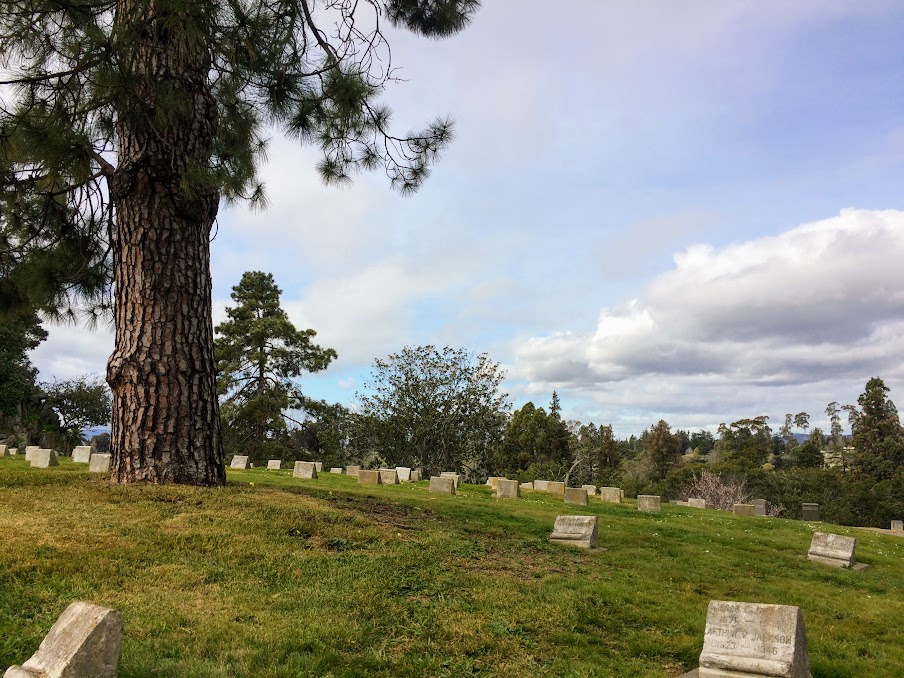
Saturday, the walking tour at Mountain View Cemetery focused on Black History Month. This tour covered spots around entire cemetery, which is quite large, so we carpooled rather than walked for most of it. Our docents were Gaye Lenahan and Sarah Calhoun, who are both very knowledgeable about the cemetery and its occupants.

First we heard about Frederick Law Olmstead who designed Mountain View Cemetery. He's best known as a landscape architect, but was also a journalist. He was hired by what is now the New York Times to research the slave economy. After touring Texas, Olmstead realized that not only was slavery morally wrong, but he believed it was expensive and economically inefficient. His subsequent writings helped inform and galvanize antislavery sentiment in the north.

Shorey plot

The first grave we visited was one I visited recently, the grave of Captain William Shorey, the 'Black Ahab'. He was the first black captain operating on the west coast back in the 1880s. He died during the Spanish flu pandemic in 1919, and is buried with his wife Julia Ann (1944) and daughter Zenobia Pearl (1909).

Then we went to an unmarked grave for Isaac and Elizabeth Flood. Isaac was born into slavery in South Carolina, but somehow made his way to California.

Elizabeth Flood
photo: BlackPast.org

Elizabeth Thorn was born a free woman in 1828 and educated in Massachusetts. When her son by her late first husband, Joseph Scott, was not allowed into a school in Sacramento, she opened a private school for black children. Elizabeth and Isaac married in 1855 and moved to Brooklyn, just outside of Oakland (the neighborhood near Highland Hospital is also known as Lynn), where she started another school in their home on East 15th. Elizabeth and Isaac went on to help found the First African Methodist Episcopal church, which eventually took over the school. Isaac helped challenge segregation laws, and their daughter, Lydia Flood, became the first black student to attend John Swett School in Oakland in 1872. Lydia went on to become active in the movement for women's voting rights. The plot is unmarked, but a docent discovered it when she noticed the name Isaac Flood on an old plot map of the cemetery and did some investigation.
more about Elizabeth Thorn Scott Flood
more about Lydia Flood Jackson

Nearby, on what is now a plot with mostly Elks Club members buried there, is another unmarked grave. This one is the final resting place of Jenny Prentiss and her children. You may remember her from the New Era, New Politics walking tour downtown—she was a former slave who was Jack London's foster mother. Her husband Alonzo is buried separately in the veterans plot, but he knew Captain Shorey and played cribbage with him.

Our next stop was a long way up the hill. Unfortunately one of the docents fell ill during the drive, and we spent some time figuring things out, then shuffling amongst cars while another docent who was along took Gaye to get checked out.

Glenn Burke

We eventually found the next marker, the grave for major league baseball player Glenn Burke. He was the first and only openly gay player in baseball, and suffered discrimination both for his homosexuality and his race. When he was with the LA Dodgers, he drew the wrath of manager Tommy Lasorda for befriending his estranged gay son, Tommy Lasorda, Jr. But he's also known for having invented the 'high five' with then teammate Dusty Baker. Burke had a rough time after a shortened baseball career, but his former teammates and the Oakland A's came to his assistance when they found out he was suffering from AIDS. Glenn Burke died in 1995 at Fairmont Hospital in San Leandro. His mother Alice died in 1999 and is buried nearby.

The next scheduled stop was for the grave of Byron Rumford, another name you may remember from the New Era, New Politics walking tour. He was the first black elected to public office in Northern California, and has a section of highway 24 named after him. Unfortunately the remaining docent didn't know the exact location of the grave, so I didn't find it until later. William Byron Rumford died in 1986, and his wife, Elsie Rebecca Rumford died in 2002.

Lil' Bobby Hutton

The grave we did find next was for Lil' Bobby Hutton, the first to join the Black Panthers. He was born in Arkansas, but his family moved to Oakland when he was three years old, after nightriders began intimidating blacks in the area. At age 16, he was the first member to join and the first treasurer of the Black Panther Party. He died April 6, 1968, when he and other Black Panthers were surrounded in a house in West Oakland. Eldridge Cleaver said Bobby stripped to his underwear to show he was unarmed, but police shot him more than dozen times. Police maintained that Hutton attempted to run away and ignored orders to stop, but one Oakland police officer who witnessed the shootout later told Cleaver that, "What they did was first degree murder." Bobby Hutton was buried in Mountain View Cemetery, but didn't get a gravestone until 2003, 35 years after his death.

Marcus Foster

Then it was back around the hill to the grave of Marcus Foster, who was the first black superintendent of the Oakland Unified School District. He was murdered by the Symbionese Liberation Army (SLA; of Patty Hearst fame) because they believed he supported student ID cards and police in schools. He and his deputy, Robert Blackburn were shot by SLA gunmen with bullets dipped in cyanide, but Blackburn survived. His wife Albertine (Abbe) died recently on December 27, 2011, and is buried alongside him.

We went past the Grand Army of the Republic plot which I visited a couple of weeks ago, and saw the grave of Obediah Summers. He was born into slavery, and his master paid for him to take his place in the Confederate army. Obediah was captured, and then enlisted in the Union army. He later became a minister, and served as the California State Legislature as its first black chaplain. He wasn't originally buried in the GAR plot, but Obediah's granddaughter Myrna Adams petitioned to have his remains moved.

Ida Louise Jackson

Nearby is the grave of Ida Louise Jackson. She graduated from UC Berkeley in 1922, and was the first black teacher in Oakland (the only one until 1934). Ida was also active in public health, working on the Mississippi Health Project which brought medical care to rural Mississippi. As international president of her sorority (the 8th supreme basileus reference on her marker), she also started a program to train rural teachers during the Great Depression in 1934. Ida Jackson died in 1996 at the age of 93.

Our last stop was an unmarked grave in the veterans plot, for Alonzo Prentiss, the husband of Jenny Prentiss. It was a long, but very interesting tour—highly recommended.

more pictures from the tour:


More Taphophile Tragics from around the world,

Tuesday, February 21, 2012

black history month: Captain William T. Shorey

William and Julia Ann Shorey

When most people think about early black history in Oakland, they think of the Pullman Porters. Less well known is William T. Shorey, who was captain of a whaling ship in the 1880s, the only black captain operating on the west coast at that time. He was known to his whaling crews as the 'Black Ahab'.

William was born in Barbados in 1859, went to sea as a teenager, and made his first whaling voyage in 1876. Whaling brought him to California, and he married Julia Ann Shelton, the daughter of a leading African American family in San Francisco. He was a skilled captain and navigator, earning his masters license which allowed him to command any size vessel anywhere in the world. He and Julia Ann had 5 children, living in West Oakland at 1782 8th Street. William retired from the sea in 1908, as the whaling industry was winding down as petroleum was discovered.


Active in politics before and after his retirement, William hosted a dinner in 1903 honor of Booker T. Washington, who spoke to raise funds for his school at Tuskegee. William died in 1919, one of many victims of the Spanish flu pandemic. Some of the influenza victims from Oakland are buried in plot 53 in Mountain View Cemetery, but William is in plot 14B. Julia Ann (-1944) and their daughter Zenobia Pearl (-1909) were also buried there. Their grave is prominently marked on the maps the cemetery provides. Nearby is a marker for William T. Shorey, Jr. (1902-1969), presumably their son.

Following his death, Shorey Street in West Oakland was named after him. He was the first black resident in Oakland to be honored by the city fathers.

more on Captain William T. Shorey:
Historical photo from the Oakland History Room at the Oakland Public Library.

More Tapophile Tragics from around the world.

Tuesday, February 14, 2012

Mountain View Cemetery: Grand Army of the Republic

Grand Army of
the Republic plot

Asection at the Mountain View Cemetery is set aside for members of the Grand Army of the Republic, or put more plainly, veterans of the Union forces in the American Civil War (1861–1865). The GAR was the first veterans' organization in the United States, and was one of the first advocacy groups supporting voting rights for black veterans.

This past weekend after the Oakland Urban Paths walk with geologist Andrew Alden, I stopped by Mountain View Cemetery to do some more exploring and take some new pictures for the Taphophile Tragics meme. I knew that Mountain View Cemetery had a section for Union veterans of the Civil War, but I'd never seen it except at a distance, so that was my goal.

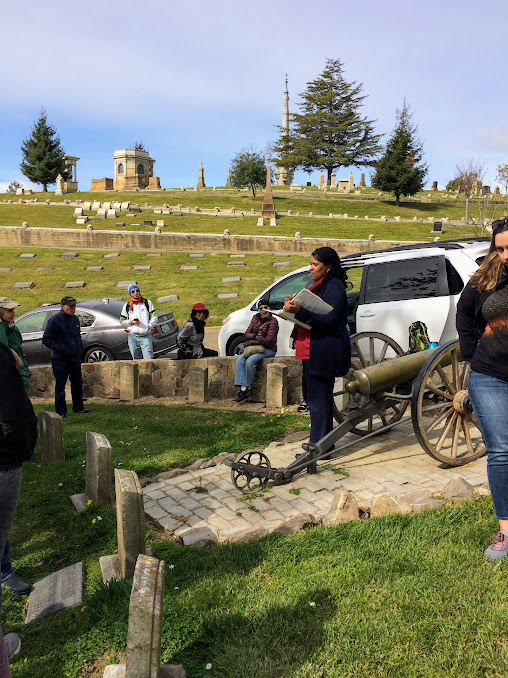
The plot was set aside for Union veterans in 1880 and burials began that fall. In 1893 the GAR dedicated a monument topped with shroud-draped urn (a symbol dating back to Roman times). Just in time for Memorial Day 1897, the plot was given a makeover, ringing it with 750 cannonballs and placing howitzers at the corners. The GAR organization was dissolved in 1956 when the last member died, and as time will do, things slowly wore down after that.

Then in 2003, Eric Kos and Dennis Evanosky gave it another makeover. Working with the cemetery staff and the Department of Veterans Affairs, they mapped the plot and replaced the broken and missing stones. Even the howitzers were restored.

Obediah Summers

What I found particularly noteworthy was the marker for Obediah Summers. He was born into slavery in 1844 in Clay County, Missouri. At age 20 in 1864, he enlisted in Company A, 18th Regiment of the United States Colored Infantry (USCI). After the war he became a Methodist preacher, and eventually moved to Oakland. He later served the California State Legislature as its first African-American chaplain. But he wasn't originally buried in the GAR plot. During the 2003 makeover, Eric and Dennis, working with Mt. View staff, discovered Obediah's grave. Obediah's granddaughter Myrna Adams petitioned to have his remains moved to the GAR lot, a request that was granted in 2005, when Obediah was able to join his fellow veterans.


See other Taphophile Tragic entries from around the world.

Monday, February 6, 2012

walking tour: New Era, New Politics

Saturday was a specially scheduled walking tour as part of the celebration of Black History Month in Oakland. It's the "New Era, New Politics" tour, and focuses on the more recent history of Oakland.

There was a great turnout, 23 people plus our guide, Renate. As when I took the tour last summer, it starts a little slow, with a lot of names and facts in front of the African American Museum and Library of Oakland (AAMLO). But I did learn some new things, such as the identity of the young boy pictured on one of the banners at the museum.

The banner shows Royal Townes, who became the first African American firefighter in Oakland, and was instrumental in helping desegregate the fire department. Royal was born in Oakland in 1899, and when denied union membership in his factory job because of his race, went to work as a railroad porter. He took the fire department application test and easily passed (he was an intelligent young man, and spoke three languages), but because of his race, his application needed a nudge from his former employer. He helped train many other black applicants to pass the test, and was scoutmaster for a Boy Scout troop that included Sam Golden, who went on to become the first African American fire chief in Oakland. There's an interesting paper at UC Berkeley about the desegregation of the Oakland Fire Department (.doc)

There was lots more we heard about, including people that should be familiar to Oaklanders, including: Delilah Beasley, C.L. Dellums, Lionel Wilson, Elihu Harris, Henry Gardner, Morrie Turner, Byron Rumford, and judge Donald McCullum. To read more about some of these names, click the links, and see my post from last year's New Era, New Politics walking tour.

more pictures:


some of the books referenced:

Special shoutout to @kenyaw who was there with lots of friends celebrating his birthday. Happy Birthday, Kenya! And a reminder to support the Oakland walking tours program—it's one of the things possibly on the budget chopping block.

Tuesday, August 2, 2011

walking tour: New Era, New Politics

The other week I took another of the city-sponsored walking tours. This one was the New Era, New Politics walking tour, which is the newest of the 8 tours the city offers. It also focuses on some of the more recent history of Oakland, though as we learned, that has connections further back, too.

AAMLO

We started the tour in from of the African American Museum and Library at Oakland (AAMLO), part of the Oakland Public Library system. Alas, since it was a Monday and the AAMLO was closed, I couldn't check out the museum afterwards. The building itself is interesting, one of 5 libraries built with funds from Carnegie. But what's of real interest are the collections it houses. In 1946, Eugene and Ruth Lasartemay and Jessie and Dr. Marcella Ford began collecting the oral histories and artifacts that documented the activities of African Americans in and around Oakland, the Bay Area and California. After combining with other collections and various moves, the collection ultimately became the AAMLO in 1994. Read more of the history of the AAMLO collections on the OPL website.

Judge McCullum

During the tour, there were a ton of names from Oakland's history, some you doubtless recognize, and probably a few you don't.
  • Did you know Jack London was raised by ex-slave Jenny Prentiss? He later borrowed money from her to buy his first boat, and left money to her in his will.
  • That section of highway 24 named the Rumford Freeway? That's named after William Byron Rumford, the first African American elected to public office in Northern California. He also was one of the early fighters against automotive air pollution. Besides the freeway, there's also an Oakland post office named after him. Ironically, it's one of the post offices slated to be shut down.
  • Oakland's Youth Court? It's named for civil rights activist and superior court judge Donald McCullum.
  • mayor Lionel Wilson was the first African American mayor of Oakland.
There were lots more people of note, including Bob Maynard, George Scotlan, Elihu Harris, Ron Dellums, C.L. Dellums, Henry Gardner, Curt Flood (I ride past Curt Flood field on Coolidge), and more.

I have to admit the names and facts were kind of a blur, because we spent the first 30 minutes standing outside the museum. It was tiring to stand in one place for so long, and it made it harder to remember the names and associated facts because there wasn't a place to associate many of them with. But it was a still a good, informative tour, and worth checking out.

More pictures in my Oakland New Era, New Politics walking tour album:
Oakland New Era, New Politics walking tour