Thursday, August 18, 2011

walking tour: Churches and Temples

Wednesday I had a chance to go on another Oakland walking tour, this time the Churches and Temples tour. As with the other tours, we had an extremely knowledgeable guide, Don Tyler, a former Oakland High history teacher who's been leading history tours since the 1970s. We were fortunate to get access inside many of the buildings, too.


First Presbyterian

Say what you will about churches building huge, fancy edifices, many of them are beautiful, interesting buildings. They're frequently one of the first things people built when they settled an area, so they tend to be some of the oldest structures around, assuming they survived fires, earthquakes, and urban renewal.

We started in front of First Presbyterian Church of Oakland, which you've doubtless seen at 27th and Broadway. I've been in the complex frequently, because that's where Habitat for Humanity East Bay has its offices, but I'd only been in the sanctuary briefly. It's a large English Gothic structure designed by William C. Hays. Its huge organ has over 4,000 pipes, the largest of which are 32 feet tall. First Presbyterian started small, meeting in a tent near the waterfront in 1853 (Oakland was incorporated in 1852), and moved a number of times before constructing the building at 27th and Broadway which was completed in 1916. The history is shown in a series of smaller stained glass windows in the church.


Temple Sinai

Then it was a short walk over to Temple Sinai. That began in 1875 when 18 businessmen formed the First Hebrew Congregation of Oakland. As with First Presbyterian, it moved several times before settling in the current location in 1913. Over the years, the congregation has included such notable Oaklanders as the Capwells (H.C. Capwell department store, later part of Emporium-Capwell), the Kahns (Kahn's department store, noted on the City Center walking tour), the Grodins (Grodin's Menswear store) and Gertrude Stein. Temple Sinai recently expanded their campus, but the 1913 structure still serves as the sanctuary.


St. Augustine's

Another short walk over the south end of Pill Hill took us to Saint Augustine's Episcopal, a smaller but distinctive church on Telegraph at 29th. Originally a black Episcopal church meeting at 27th and West, it merged with Trinity Church at 29th and the combined church kept the name St. Augustine's. The original St. Augustine's is notable because it became a "political and spiritual haven" for the Black Panthers, so it was big news when it merged with the predominately white Trinity Church. The building is a vivid rust red color (you've seen it if you've ever been to the Commonwealth Cafe and Pub across the street) and is built of wood. Inside is stained and varnished, with fine details and a warm color. Additional decorations around the wainscoting are done with lincrusta, a molded linoleum and wood product made to mimic more expensive carved wood. The building was designed by architect William Hamilton. In an amazing bit of timing, earthquake retrofit work was completed on the building just months before the 1989 Loma Prieta earthquake struck, and the building came through fine. Read more about St. Augustine's in Annalee Allen's Tribune article.

Walking down Telegraph to 21st we came to First Baptist Church. The building was completed shortly before the 1906 earthquake, and was badly damaged in the quake. Julia Morgan (the Morgan family lived nearby) had been hired to finish the sanctuary, and was instead hired to repair the church and finish the sanctuary. Many Baptist churches are relatively plain in design; First Baptist is not, with fine wood carving, an open redwood ceiling, and lovely stained glass windows around. The building itself is based on the cathedral in Aachen, Germany, designed for Holy Roman Emperor Charlemagne. A large pipe organ (the sister instrument to the well-known organ in the Stanford Chapel) sits at the front. The sanctuary was featured in the movie "What Dreams May Come". While the First Baptist congregation merged with Lakeshore Baptist in 2010, the building is still in use by the Burmese Mission Baptist Church.


Christ the Light

We then headed towards Lake Merritt to see Christ the Light Cathedral, which was completed in 2008. Unfortunately we arrived just as mass was beginning, so we couldn't go in the sanctuary, but we did take a brief tour of the mausoleum below. In what's a common theme, this building was built to replace the original cathedral that was damaged beyond repair in the 1989 Loma Prieta earthquake.

From there we headed over to the all-brick St. Paul's Episcopal. That was likewise unavailable because of a service, but we stood outside and talked about the retrofit work that has been done to the building -- un-reinforced masonry doesn't do well in earthquakes, though St. Paul's survived Loma Prieta with only minor damage. The Gothic Revival style building was constructed in 1912, and designed by Benjamin Geer McDougall.


First Congregational

After noting the former site of the Piedmont Baths next to Whole Foods, we headed over to First Congregational Church. At this point we were behind schedule, so we didn't get to spend too long there, but it's an interesting building. And F.M. "Borax" Smith was a noted member. The Italian renaissance building with its distinctive tower was designed by John Galen Howard, and opened in 1925. I would have happily kept walking around learning about the churches, temples and people behind them (with a break for lunch, of course), but we were past our scheduled time so we headed back to Broadway where we began the tour.

Lots more pictures:


This is hardly all the notable places of worship in downtown, never mind all of Oakland: the Julia Morgan-designed College Avenue Presbyterian in Rockridge, the First Church of Christ Science on Franklin and 17th, the Greek Orthodox Cathedral, and the Mormon Temple in the hills come immediately to mind. There are lots of other interesting, historical churches and temples around the rest of Oakland, waiting for you to explore.

Additional coverage:
Oakland North

Wednesday, August 17, 2011

upcoming Oakland events

The big event this weekend is the Art & Soul Festival, but as usual, there's lots of other stuff going on if that's not your thing.

Waterfront Flicks - Thursday, August 18, sundown at Jack London Square. This week's movie is Dinner for Schmucks. There will be food from Miss Pearl's Jam House, beer from New Belgium via East Bay Bike Coalition, and cooking demos. (free)

Faith Fancher breast cancer walk - Saturday, August 20. Those of you have been in Oakland for a while may remember Faith Fancher, a KTVU reporter. She fought breast cancer for 6 1/2 years, but succumbed in 2003. A fund-raising walk for local, under-served and under-insured breast cancer victims is held each year in her memory. See the Friends of Faith website for more info.

Art & Soul - Saturday and Sunday, noon to 6pm. The 11th annual Art & Soul Festival. K and I had a great time when we went in 2009. There's music, art, food and fun for all ages ($10/$15).

Uptown Bike Tour - Sunday, August 21, 10am-noon. Take a bike tour around uptown and beyond with the Oakland Museum.

Urban Paths walk - Sunday, August 21, 10am-noon. Join Oakland Urban Paths for a walk in Montclair, on some of Oakland's steepest and woodsiest urban stairways.

Plus the usual events:
Piedmont Avenue Art Walk (3rd Thursday)
Bites off Broadway (Fridays)
Dancing under the Stars (Fridays)
Art Murmur (1st Friday)
Downtown walking tours (Wednesdays and Saturdays)
OHA walking tours (Saturdays and Sundays)
Saturday Art Stroll (Saturdays)

For more, check the Visit Oakland event calendar.

Looking further ahead:
Park(ing) day - Friday, September 16.
Taste of Temescal - Tuesday, September 20.
Parlor and Politics - Saturday, October, 1. A celebration of women's suffrage in California.

Tuesday, August 16, 2011

signs: the Print Shop

Print Shop

Along San Pablo Ave. is this dated-looking sign for the Print Shop. I can't find any business listing at the location of the sign, but it's not connected with PSPrint on Mandela Parkway. (Thanks for the info, Jennifer! See her comment for more info.)

Monday, August 15, 2011

Throw Down for the Town

Saturday was a city-wide event organized by the Ella Baker Center. People of all ages and from all walks of life came out to help make Oakland a better place. There were a variety of service projects all over Oakland, including cleaning up parks, wetlands restoration, working on community gardens, building homes with Habitat, creating a dog park, and working with seniors.

I chose wetlands restoration, which was an event with Save the Bay at the Martin Luther King, Jr. Regional Shoreline. I selected it in part because I wanted to try something different, and it was an excuse to ride along more of the SF Bay Trail. When I got the confirmation email with directions, I found out it was also the 50th Anniversary for Save the Bay, and it was going to a shortened work day plus a celebration. I considered signing up for a different event, but in the end I'm glad I went to this one. While they had a full contingent of volunteers, it turned out I was the only one who was there as part of Throw Down for the Town.

at MLK Shoreline

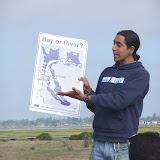
We started with a brief introduction to Save the Bay, how it was started, and the work they do now. On hand were dozens of volunteers, including a group from NBC Bay Area as part of their Bay Area Proud program. We then split up into different groups, to water new plantings, weed invasive species, pick up trash, and prepare for the celebration later. I joined the group weeding; one of the Save the Bay habitat specialists showed us what we were looking for, and off we went. Although the area has been under restoration for some time and is in general doing very well, there was a large amount of English plantain in one stretch, so we didn't have far to go to get to work.

at Mosswood Park

After a couple of hours of work, we wrapped up and got down to celebrating Save the Bay's 50th anniversary. There were games, a raffle, photos with the Save the Bay shark, various things for lunch, and mimosas or wine from Barefoot Wine & Bubbly. NBC Bay Area interviewed various people for sound bites, and we did a group shot with everyone shouting "happy 50th anniversary, Save the Bay!".

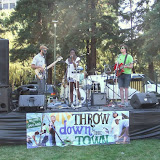
When I went to head off to Mosswood Park for the Throw Down for the Town party, I discovered I had a flat tire. Fortunately I was able to get a ride (thanks, Dylan!), and after a brief stop at Manifesto Bikes to fix the flat, headed over to the party at Mosswood Park.

What did you do for Throw Down for the Town?

more photos:
Save the Bay
Throw Down for the Town

more coverage:
Ella Baker Center blog
Oakland Local
Oakland North

Thursday, August 11, 2011

walking tour: City Center

city hall

Wednesday I went on the City Center downtown walking tour. I was pleasantly surprised to see Annalee Allen herself ready to lead the tour. Also on the tour was C.M. Wilson of OakSnap. (We didn't recognize each other at first, but it's been several years since we last met in person.) There were about 16 of us altogether. Special shout-out to new Oakland resident [C,K]atherine! She and her fiancé moved to Oakland 2 months ago, and she was exploring Oakland via the walking tour.

The City Center tour was more focused on architecture than some of the other tours, and in particular on city hall. It's not surprising, because it is an amazing building and is on the National Register of Historic Places. Construction began in 1911 and finished in 1914, and at the time it was the tallest building west of the Mississippi and the first high-rise government building in the U.S. It's in the Beaux-Arts style, and is an impressive, lovely part of the Oakland skyline. It was part of the wider City Beautiful movement, under the tenure of then mayor Frank Mott. If you've never been there for a council meeting or the like, the wider base contains the mayor and city council offices, as well as various meeting chambers. The upper tower contains offices, and a jail on the 12th floor that's been unused since the 1960's.

But that almost went away in the 1989 Loma Prieta earthquake. Although the building was constructed after its predecessor was destroyed in the 1906 San Francisco earthquake, it didn't fare well in 1989. The building was red-tagged, and was in danger of being destroyed. With some help from FEMA and a lot of work, the building was retrofitted to be earthquake-resistant. Steel beams were added to reinforce the structure, and the entire building was placed on base isolators. As a result, the entire building can move up to 20 inches in an earthquake to protect the inhabitants.

rotunda dome

We also went into the Rotunda building, which formerly housed Kahn's department store. If you haven't been inside, you really, really need to go. It features an amazing glass dome, of the sort they "just don't make anymore".

We also checked out the Lionel J. Wilson building, modeled after the flatiron building in New York, the Tribune tower, the Clorox building and others before ending up at City Center. We got a bit of history on the rise and fall and re-rise of shopping in Oakland, brought on by a variety of things including the rise of the automobile, the building of the Bay Bridge, the construction of BART, and other factors. We finished the tour in the City Center plaza, where they were setting up for the weekly free Wednesday concert. Definitely worth taking the tour to get the scoop on some of the downtown architecture and history behind it.

more pictures:
Oakland City Center walking tour